The Startup That Told Schools Its AI Was “Intelligent Enough to Not Need a Trained Librarian”
What Librar Labs is, who built it, where the money came from, and what schools should know before signing a contract. The documented criticism here originates with Elissa Malespina; this piece follows her work.
On Librar Labs’ own website, the example it gives of what its AI can do for your library is a question: “Which students have not borrowed anything in three months?” The company lists that as a feature.
Librarians spent a century building the opposite rule: that what a child reads is nobody’s business but theirs.
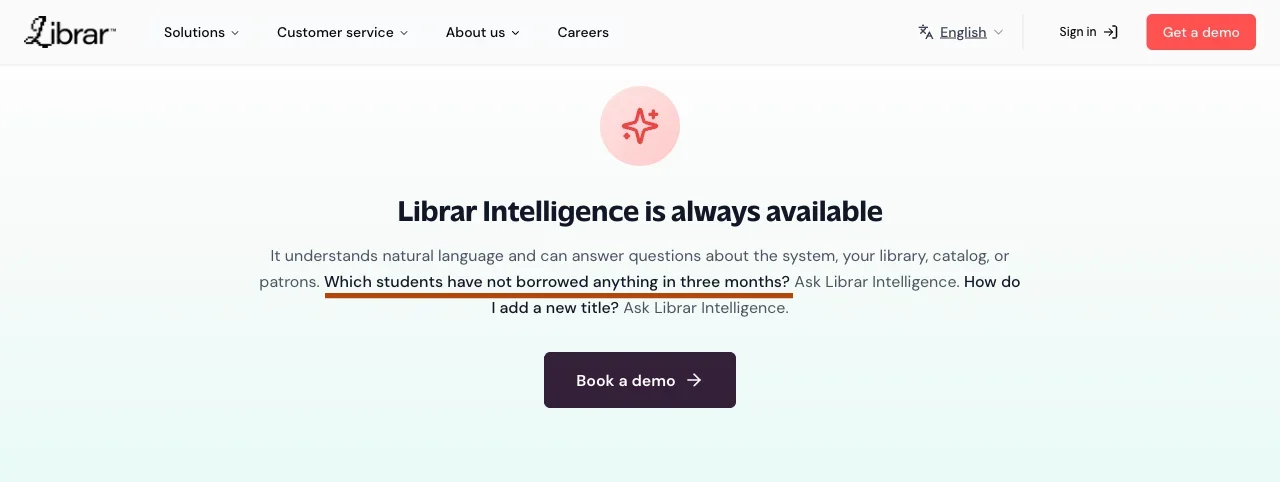
This piece is about the startup behind that question. “Which students have not borrowed anything in three months?” Why do you need to know?
Who built it, who funded it, and what a school cannot find out before it signs.
The three people who built Librar Labs are running a company that the CEO has, on his own LinkedIn, described as “a $15M (edit: currently $110M) startup.”
The CEO’s most recent education entry, per his profile, is “high school, 2022 to 2024” with no university listed. His five years of listed employment, 2017 to 2022, are competitive gaming.
The co-founder, per his profile, graduated from a Swedish private high school in June 2025 and also lists competitive gaming as employment.
The CTO is the only founder with a university degree, an M.Sc. from Lund University.
What the company says
Librar Labs is a Y Combinator Winter 2026 company. Their tagline as of late May 2026 is “Intelligence for culture.”
They previously used “The data and intelligence layer of literature,” and before that, “Intelligence for physical knowledge, starting with libraries.”
The OSSUS website, a sibling brand the same founders operate, describes the company as “self-healing data infrastructure that turns fragmented records into trusted, agent-ready systems of truth.”
Their product, also called Librar, is marketed as an integrated library system for K-12 schools. The Y Combinator launch post described it this way:
“Librar Labs (YC W26) Labs have built the AI librarian that saves library staff hundreds of hours and inspires kids to read.”
The marketing copy on their website said the system was “intelligent enough to not need a trained librarian” and could be used “even before you find a librarian.”
That language is what Elissa Malespina caught first. The company has since removed it and published an apology, which I will get to.
What the company has not removed, as of this writing, is the use case displayed on their Solutions page: its natural-language interface still advertises the example query “Which students have not borrowed anything in three months?”
There is a long professional tradition in libraries of treating borrowing histories as confidential information. Librarians did not invent that tradition because they liked paperwork.
They invented it because patrons who feel surveilled stop reading freely.
The American Library Association’s Code of Ethics says reading records are protected.
Forty-eight states plus the District of Columbia have library confidentiality statutes that codify it.
The Librar Labs Solutions page displays “Which students have not borrowed anything in three months?” as one of two example queries for its natural-language interface.
The page does not contradict the apology statement’s claim that recommendations do not use individual borrowing history.
They describe different surfaces of the product, and both can be technically true.
The apology
On May 24, 2026, the company published a statement titled “Librarians, AI, and where we got our framing wrong.” It addresses the two phrases Elissa pointed out. It explains that the original copy was aimed at European schools without library systems, where the Swedish school-librarian shortage is the implied context. It commits to rewriting the messaging. It says, plainly:
“We’re not trying to replace librarians.”
The same statement makes several claims about how the AI features work:
- AI features are optional and selected school by school.
- Recommendations use population-level anonymized patterns, not individual borrowing histories.
- Personal data is never used to train AI models.
- Patron data is deleted in full when a school leaves the platform.
These are reasonable claims. I want to take them seriously. I also want to note what the apology does not address.
The apology refers, in three different sentences, to “recommendation models,” “AI models,” and “responsible cloud service.”
None of these phrases names a vendor. They do not list OpenAI, Anthropic or Microsoft’s Copilot.
The privacy policy on the live website refers to “trusted processors needed to run Librar (e.g., hosting, email delivery).”
Neither names a vendor.
The Responsible Disclosure page does not name a vendor.
The Solutions page does not name a vendor.
The Careers page does not name a vendor.
The third-party report of Elissa Malespina’s direct LinkedIn conversation with co-founder Carl-Hugo Jacobsson, in which she got six specific clarifications about data handling, does not name a vendor.
That’s the problem. They won’t name who their vendors are.
I want to be clear about the scope of that claim. I have not reviewed an executed Librar Labs contract or data processing agreement. Those documents might disclose more.
The claim is limited to the public pages a school’s procurement officer can read before signing.
If a vendor’s executed Data Processing Agreement discloses subprocessors that the public surfaces do not, that resolves the gap on a per-contract basis. It does not resolve it for the schools still in evaluation, who have to make a decision based on what they can read.
Why does naming the subprocessor matter?
Because the subprocessor is who actually holds your students’ data. Its security is your security. Its data-handling terms are the ones your students live under, whether or not you ever read them.
Is it a spreadsheet or a protected database?
And any of those companies can be sold on its own timeline, which moves your students’ records to an owner you never evaluated.
Here's the deal, schools cannot make informed choices about a vendor that does not disclose its subprocessors on the surfaces available before a contract is signed.
This is a transparency problem.
It applies to many vendors, not just this one. OverDrive didn’t provide the answer, either.
Who built this
The three Librar Labs founders are Jonathan Görtz (CEO), Kaan Sirin (CTO), and Carl-Hugo Jacobsson (Co-founder). Per their LinkedIn profiles, each of them completed their most recent full-time education within the last twelve months or less.
Jonathan Görtz lists, under Experience, five years at Blizzard Entertainment from 2017 to 2022. The role is “Competitive gaming.” Under Education, he lists “Y Combinator” and “high school, 2022 to 2024.” There is no university.
His summary section reads: “Backed by top engineers and scientists from OpenAI, Scale, and Palantir to build intelligence for culture.”
The phrasing matters.
“Engineers and scientists from” those companies. Not the companies as institutional investors.
Individuals.
His prior startups are Cyberboost (offensive hacking tools; his profile marks it acquired in October 2023, though UK Companies House shows Cyberboost Limited was not incorporated until November 2023, which makes that acquisition date impossible as stated) and Teachr (described as “GitHub for teachers,” founded February 2024, acquired January 2025).
Both list the word “Acquired” but do not name the acquirers.
Between Teachr and Librar Labs, he worked as a Debian Open Source Developer for nine months, January through September 2025, on what he describes as “open source projects used by tens of thousands.”
In an autobiographical post on his LinkedIn from approximately three months ago, he described the company as “a $15M (edit: currently $110M) startup.”
Carl-Hugo Jacobsson, the co-founder, lists under Experience two and a half years at Supercell, in competitive gaming.
He graduated from a Swedish private high school in June 2025. He ran a Swedish youth job-platform called Ungdomsförmedlingen for three years, until December 2025, after which he joined Librar Labs as co-founder. His profile lists no university degree.
Kaan Sirin, the CTO, is the only founder with a university degree. He has an M.Sc. in Industrial Engineering and Management from Lund University, completed in 2025. His Top Skills are Probability Theory, Python, and Data Analysis. His Honors and Awards section names a first-place finish at the World Informatics Olympiad. Before Librar Labs he worked at Modulai as an AI Engineer on knowledge distillation in large language models, and at Sectra as a software engineer on medical AI models.
A fourth name sometimes appears alongside these three: an early software engineer whose own LinkedIn says his role was Software Engineer, not Co-Founder, with a tenure of September 2025 through February 2026. That start date is two months before Görtz and Sirin’s own stated founding date of November 2025, which strongly suggests the project began informally during Görtz’s Debian work in September 2025, before formal incorporation.
He left in February to finish his degree. He is a student, and he is not named here.
I am writing all of this in primary-source form because the team is what their public profiles say they are.
They are very young.
Two of three founders list professional competitive gaming as employment.
One of three has a university degree.
They are running a Y Combinator-backed company that the CEO has described on LinkedIn as “a $15M (edit: currently $110M) startup,” with K-12 schools in the United States and Europe among its named customers.
The Y Combinator LinkedIn launch post for Librar Labs describes the team as “quantum physicists, exited founders and dropouts … backed by founders and operators from OpenAI, Depict, Kahoot and many more.”
That post is still on YC’s verified organization page as of late May 2026. The CEO graduated high school in 2024.
The co-founder graduated high school in June 2025.
The CTO completed an M.Sc. at Lund in 2025. None of the three founders list a physics degree, a physics publication, or any quantum-related employment on their LinkedIn profiles.
I do not think these facts are individually disqualifying. I do not believe a person needs an MLIS to build software useful to libraries. I do not believe a person needs a college degree to be technically competent. I am quite sure all three of them can write code that works. The question is not whether they are competent.
The question is what schools are signing up for when they sign a contract.
The credentialed librarian
In April 2026, Librar Labs hired Karin Wannerud. Per her own LinkedIn post she describes herself as “joining a start-up at 51.”
She holds a 1999 Master’s degree in Library and Information Science from University College of Borås, which houses the Swedish School of Library and Information Science, a recognized Swedish library science institution.
Her credential is real and her library identity is genuine. When she calls librarians “my guild” in her own LinkedIn posts, the word carries weight. Her library tenure at Internationella Engelska Skolan was four years and nine months, during which she rose to a coordinator role she describes in her own post as covering “48 librarians all over Sweden.”
Before she began her library career in 2021, her listed career was two decades of research, private-equity, and M&A-advisory work, including years at one of Europe’s largest private-equity firms.
When co-founder Carl-Hugo Jacobsson announced her hire on LinkedIn in April 2026, he wrote: “Karin brings experience from running a large organisation of libraries, but she’s also worked within PE and the private sector for 15+ years. The perfect combination of experiences.” Both halves of his description are documented on her LinkedIn.
Where the money came from
Per PitchBook, the institutional record for private-company financing, Librar Labs has raised five hundred thousand dollars total across two completed deals: the Y Combinator Acceleration round on January 1, 2026, and a Seed Round on March 18, 2026.
The CEO has described the company on LinkedIn as “a $15M (edit: currently $110M) startup,” figures that refer to valuation rather than capital raised. An Instagram reel promoting the company claims “15M+ raised.”
That claim and PitchBook’s five-hundred-thousand-dollar figure cannot both be precise. I cite both and let the reader weigh which is the institutional record.
Librar Labs has five named investors per PitchBook:
- Florent Venture Partners
- Pioneer Fund (the YC-alumni syndicate at pioneerfund.vc, founded 2017, no relation to the unrelated 1937 organization of the same name)
- Stockholm School of Economics
- Wave Ventures
- Y Combinator
The most relevant of these for the larger story is Florent Venture Partners, managed by Christian Dorffer.
His LinkedIn says he is Librar Labs’s Pre-Seed Investor. Florent Venture Partners is based in Luxembourg per his profile and was founded by Dorffer in September 2025.
Before Florent, Dorffer spent seven years as Managing Partner and Chairman of Sweet Capital, which his LinkedIn describes as “an investment fund, created and funded by the founders of King Digital Entertainment (acquired by Activision).”
Activision Blizzard’s acquisition of King Digital Entertainment, the maker of Candy Crush, closed in 2016 at a reported price of approximately $5.9 billion.
Between Sweet Capital and Florent VP, Dorffer ran a personal-capital fund called Florent Nano LLC, with four named limited partners: Christian Dorffer, Nolan Gray, Lars Rasmussen, and Mads Rydahl. Lars Rasmussen is one of the co-founders of Google Maps, originally as part of the company Where 2 Technologies that Google acquired in 2004.
This resolves a question I had been carrying for several days. The OSSUS website displays a logo set titled “BACKED BY” with the subhead “Backed by founders and operators to organize the world for the superintelligence of tomorrow.” One of the logos is Google Maps.
I had been asking which Google Maps the affiliation refers to: the company, or an individual. Dorffer’s LinkedIn answers it. The Google Maps affiliation is Lars Rasmussen, personally, as a named LP in Dorffer’s prior personal-capital fund.
The “Backed by founders and operators” framing OSSUS uses is consistent with this: individuals from those companies, not the companies as institutions. I do not believe Anthropic, OpenAI, Palantir, or Scale AI are institutional investors in Librar Labs.
The PitchBook record does not list them. Görtz’s own LinkedIn says he is “backed by top engineers and scientists from OpenAI, Scale, and Palantir.” Engineers and scientists from those companies.
Individuals. The same pattern.
Wave Ventures, another of the five named investors, is a Helsinki and Stockholm based student-led venture fund founded in 2017. It lists Librar Labs in its public portfolio page verbatim as “Librar Labs - AI for librarians.” The fund’s third vehicle, Fund III, closed in May 2025 at seven million euros. Per the Finnish Venture Capital Association’s writeup of that closing, the named limited partner categories include the founders of Slack, Bolt, Skype, Supercell, Wolt, Silo AI, and Smartly.io, alongside European early-stage venture funds and family offices.
What is documented above is the publicly disclosed structure of Librar Labs’s named investors and, where their fund managers or LP bases have spoken to it publicly, the disclosed origins of the capital those funds hold. I am recording these capital lineages as documented on the funds’ and managers’ own surfaces and on the Finnish Venture Capital Association’s surface. I am not extending them into claims about the relationships between Librar Labs’s founders and any individual investor or limited partner.
What’s actually being shipped
Three founders.
One credentialed librarian.
One early software engineer who started in September 2025 and left in February 2026 to go back and finish his degree.
The company’s own careers page, as captured on the Wayback Machine, lists a Head of AGI role with roughly four hundred thousand dollars per month of expected token spend against a salary expectation of roughly one hundred fifty thousand dollars per year.
The math is approximately ninety-seven percent of that role’s monthly budget going to a foundation model lab Librar Labs has not named on any of its public customer-facing surfaces.
What schools evaluating Librar Labs in 2026 can read on the public surfaces is the product. What they cannot read is the identity of the foundation model provider whose tokens are, per the company’s careers page, the largest single line item in at least one engineering role’s expected budget. Both are part of what schools sign for.
Only one is visible before they sign.
What this is part of
The structural argument I want to land does not begin with Librar Labs.
It ends with Librar Labs.
What's interesting is that on LinkedIn on May 23, 2026 by Patrick “PC” Sweeney, the Deputy Director of EveryLibrary Institute, in a comment on a post by Nicole Pagowsky, a Full Librarian and LIS Adjunct Faculty member who circulated Elissa Malespina’s ALA criticism. Sweeney asked, publicly:
“I’d love to know if this company is one of the many owned by the same Private Equity Firm that owns dozens of other vendors including LS&S (the library privatization company).”
He then added:
“Most of the vendors are private equity now. Marshall Breeding has the most comprehensive data.”
EveryLibrary Institute is a national library-advocacy nonprofit. Marshall Breeding is the library-technology analyst whose annual Library Systems Briefing in American Libraries Magazine is the canonical industry survey.
He has documented the consolidation of library-technology vendors under private-equity ownership across the past two decades.
Breeding’s 2026 Library Perceptions Report, published May 21, 2026, draws on 2,220 survey responses across the international library technology marketplace.
The report opens with the observation that “survey results reflect a deeply consolidated marketplace with top vendors responsible for multiple products.”
It also notes, in the same Notable Observations section, that “no libraries mentioned interest in AI technologies.”
That is the data point worth pausing on.
Librar Labs is selling AI-librarian services into a market where the largest current survey of library practitioners found zero respondents who volunteered AI as a priority.
The product, as marketed, does not appear to be matched to a demand that librarians themselves articulated in their answers.
To answer Sweeney’s specific question: per PitchBook’s public record, Librar Labs’s investors are Florent Venture Partners, Pioneer Fund, Stockholm School of Economics, Wave Ventures, and Y Combinator. LS&S (Library Systems & Services) is privately held by an investment group that, by all publicly available reporting, does not appear in that investor list.
To the extent the question was “is this the same PE firm,” the answer based on public records is no.
Sweeney’s framing was private equity specifically. The broader pattern across library-technology vendors over the past decade, as documented by Breeding’s research and by publicly reported events, includes private equity acquisitions, strategic-acquirer and holding-company acquisitions, and one bankruptcy.
The ownership types are not identical and the cumulative direction is the same: established library-technology vendors are moving under outside ownership at scale.
| Vendor | New owner | When / scale |
|---|---|---|
| Follett School Solutions | Francisco Partners (private equity) | Sept 2021 |
| Ex Libris | Clarivate | 2021, ~$5.3B |
| SirsiDynix | Constellation Software (Harris) | Dec 2024 |
| OverDrive | KKR (private equity) | 2020, ~$775M |
| Baker & Taylor | Chapter 11 bankruptcy, wound down | Ceased operations Oct 2025; filed Chapter 11 March 2026 |
This is the structural pattern: a library-vendor market with substantial private-equity ownership across the past two decades.
Librar Labs is not one of the established consolidators. It is a new entrant in the same environment. An earlier version of the company’s YC profile, as captured by third-party startup-tracking sites, described the first commercial product as “for the publishing industry with a focus on school libraries.”
External commentators including StartupHub.ai have described the school product as a market-entry layer for a broader data-infrastructure play. Librar Labs has not publicly endorsed that framing.
What schools should know
If you are a school librarian, a district technology coordinator, a principal evaluating Librar Labs or any similar vendor, or a school board member voting on a library-technology budget line, here is the generic procurement discipline to bring to any vendor at this stage.
Read the privacy policy carefully.
Specifically, look for the section on subprocessors and data sharing.
If it does not name vendors, that is a problem.
The Librar Labs privacy policy on May 26, 2026, said: “We do not sell your data. We share it only with trusted processors needed to run Librar (e.g., hosting, email delivery), under strict data protection agreements.”
That is the entire third-party disclosure. No subprocessors are named. No cloud provider is named. No AI model provider is named.
Your students’ borrowing histories, search queries, and reading patterns are going somewhere. Schools have a right to know where.
Ask the vendor to name every subprocessor in writing.
A reasonable vendor will provide this.
An evasive vendor will not. If the vendor will not, document the refusal and put it in your procurement file.
Ask about the natural-language interface. If the vendor offers AI assistance that can answer questions about your students by name (“Which students have not borrowed anything in three months?”), ask who can query that interface, what logging is in place, what role-based access controls exist, and how patron privacy is preserved when staff queries reference individual students.
Compare against alternatives.
Open-source alternatives exist: Koha, an ILS with global deployment, and the Palace Project and Library Simplified, run by LYRASIS over commercial digital-lending platforms. None are turnkey replacements for a managed commercial vendor, but knowing your alternatives is how you negotiate from a position of strength, even if you never switch.
Look at the dependency stack.
When you sign with any library-technology vendor in 2026, you are signing with the foundation-model lab they buy compute from, the cloud provider they host on, the data-integration vendor they use to clean metadata, and the analytics vendor that processes the resulting reports. Each layer has its own terms of service and data-handling practices, and can be acquired separately. Schools that procure a single-vendor contract are actually procuring the entire dependency stack. Demand visibility into all of it.
Document everything.
When a vendor representative makes a verbal claim during a sales call, follow up by email and ask them to confirm in writing. Save the email. When a vendor’s marketing copy says something that turns out to be revised six weeks later, save a screenshot of the original. Procurement files are evidence files. Build them accordingly.
What the search results show
I want to close with one last finding, because it changed how I think about this.
I asked Google for “Librar Labs” and read the AI-generated overview Gemini surfaced at the top of the results. Verbatim, the overview describes the company as “an AI-native company focused on building the ‘data and intelligence layer’ for school and organizational libraries.”
It says AI features are optional.
It says recommendations are based on school-level popularity rather than individual borrower history.
It says Karin Wannerud joined to assist with operations, bringing experience in managing large library organizations.
It does not mention the company’s $110 million valuation.
It does not mention the $400,000 per month expected token spend disclosed on the company’s own careers page for the Head of AGI role.
It does not mention the founders’ competitive-gaming employment listings.
It does not mention the four shifting taglines.
It does not mention the six surfaces where the company has not named a subprocessor.
It does not name Elissa Malespina or the criticism cycle this piece builds on.
Gemini’s AI overview is among the first things many school administrators will see when they do a quick search on a vendor. In this case, the overview closely tracks Librar Labs’s own marketing language and surfaces little of the documented material outside the company’s own surfaces.
This is the deeper structural problem I want schools to understand.
Even if Librar Labs is exactly what it says it is, the information environment surrounding it is filtering out the parts that would help schools make informed choices. Procurement committees doing modern due diligence are not encountering the founders’ LinkedIn profiles, the PitchBook record, the Solutions page surveillance line, the dependency-stack arithmetic, or the institutional questions EveryLibrary has been asking publicly.
They are encountering the AI overview. The AI overview is a marketing artifact.
Schools have a right to make informed choices. The information environment is not currently set up to let them. That is not Librar Labs’s fault. That is a much bigger problem. Librar Labs is the case study that makes it visible.
What I want to ask
I want to ask Librar Labs the questions schools cannot get answers to from the public materials:
- Which AI model provider processes your students’ queries? Anthropic Claude, OpenAI, Google Gemini, or another?
- Which cloud provider hosts the data?
- Which subprocessors handle any portion of personally identifiable information from your students?
- What is the company’s actual headquarters? Librar Labs lists a Newark, Delaware corporate address on LinkedIn, a San Francisco area-code phone and “San Francisco” on its YC-adjacent listings, and a “Stockholm, Sweden” headquarters on PitchBook, alongside a librar.se Swedish domain and a librarlabs.com US domain. Each is true on some surface. Which one is operational and which is administrative?
- What does the company’s exit timeline look like, and what happens to school data if you are acquired?
- How much total capital have you actually raised, and is the figure on Instagram accurate or is the PitchBook record accurate?
- What is the relationship, if any, between Librar Labs and Tribe AI, the consulting firm that built the GenAI features in Follett Destiny, your direct competitor that you have publicly described as “owning 95% of the US market” and “eating alive”?
- How many of the schools listed in public customer announcements are paying customers versus pilot or trial customers?
- What does “more than doubled reading rates” mean as a measured metric? Circulation? Comprehension? Engagement? Time spent reading?
- What independent privacy or bias audits has the company completed since Carl-Hugo Jacobsson said the company had not yet undergone any?
If anyone from the company would like to answer these on the record, I will print the answers verbatim in a follow-up. My email is in the byline. The questions are open.
Credit and acknowledgment
Elissa Malespina did the original work. Her three Substack pieces in The AI School Librarian Newsletter on May 19, May 21, and May 24, 2026, are the reason this piece exists. Her Librar Labs coverage includes “Can AI Replace Librarians? Some Companies Already Think So,” “Why Is ALA Giving a Platform to a Company Promoting ‘AI Librarians’?,” and “After My Librar Labs Articles, The Company Reached Out Directly,” along with “The Future of Libraries Shouldn’t Be Decided Without Librarians.” She also got the company’s co-founder to engage in good faith conversation, which produced the documented clarifications that this piece relies on for many specific claims about how the AI features work. Anything in this piece that documents the company’s stated practices traces back to either her reporting or the company’s own statement of May 24, 2026.
Nicole Pagowsky, Ph.D., a Full Librarian and LIS Adjunct Faculty member, amplified Elissa’s argument with academic-credential weight on LinkedIn in late May, generating two hundred and five reactions and thirty-three reposts in the librarian professional community. Her post made the structural critique visible to a much broader professional audience.
Patrick “PC” Sweeney, Deputy Director of EveryLibrary Institute and co-author of two books on library funding advocacy, asked the private-equity-ownership question in public on LinkedIn. He named Marshall Breeding as the source for the broader data on library vendor consolidation. Sweeney’s question is the question this piece picks up.
Marshall Breeding’s annual Library Systems Briefing in American Libraries Magazine and his ongoing work at librarytechnology.org are the underlying empirical foundation for the structural pattern of library-vendor PE consolidation. I did not do that work. I am building on his.
Aaron Tay, an Academic librarian in Singapore and a member of the FORCE2026 organizing committee, observed in a comment that “whether you are pro or anti-ai this seems an odd decision by ALA.” He is right.
The Librar Labs founders are very young. They are operating inside a venture-capital framework with documented patterns. I do not believe they invented the structural problems this piece describes. The piece is about the structure, not the people inside it.
Schools deserve more disclosure than they currently get from any vendor operating at this stage. They deserve the chance to weigh both halves of any team they hire and both ends of any capital pipeline they buy into. That is the conversation that should happen before contracts are signed.
Receipts · sources & credit
This investigation builds on Elissa Malespina's reporting in The AI School Librarian Newsletter (Substack), May 19, 21, and 24, 2026, and the company's own statement of May 24, 2026 (“Librarians, AI, and where we got our framing wrong”). Founder and team facts are read from the named individuals' own public LinkedIn profiles; financing figures are per PitchBook; the Solutions-page query line was captured to the Wayback Machine on May 26, 2026 (archived copy). The Y Combinator “quantum physicists, exited founders and dropouts” line is from YC's own LinkedIn launch post. The library-vendor consolidation pattern draws on Marshall Breeding's work at librarytechnology.org and his 2026 Library Perceptions Report.
What this is and isn't: a structural argument, not a personal one. It does not claim the founders are dishonest, that the company is concealing wrongdoing, or that its investors are the same as any other vendor's. Where a claim is an inference rather than a documented fact, the text says so. The full primary-source archive (captures, SHA-256 hashes, Wayback timestamps) is maintained as a defensible record. Any inaccuracy is the author's; corrections welcome at the byline address.
How these filings are sourced: Method.
New filings
One note when something actually changes. Quiet by design, no sponsors, no kickbacks, no upsell.
Follow by RSS. No form, no third party, nothing collected.
Filed June 2026. No corrections to date.