Who’s behind Libby?
The app is familiar. The companies and investment funds behind it deserve a closer look.
Revised reporting draft
Ask where someone gets their library ebooks and the answer may be “Libby.” The app is the part they see. The library buys access, chooses a collection, and helps when something goes wrong.
Libby is made by OverDrive. The official product page identifies the maker. To understand the business behind the service, the next step is a transaction record.
Your library licenses a service. That gives it a reason to understand who controls the company providing it.
Start with the dated record
On June 9, 2020, OverDrive announced that its acquisition by KKR had completed. The release distinguishes completion from the agreement announced in December 2019, identifies Rakuten as the seller, and says financial terms were not announced.
The fund paragraph names KKR America’s XII Fund as the investment vehicle. That detail matters: an investment manager’s name is not, by itself, a complete map of the legal entities or investors behind a company.
This is an OverDrive-issued release. A copy distributed through a newswire is the same issuer’s account, not a second independent confirmation.
The separate Simon & Schuster transaction
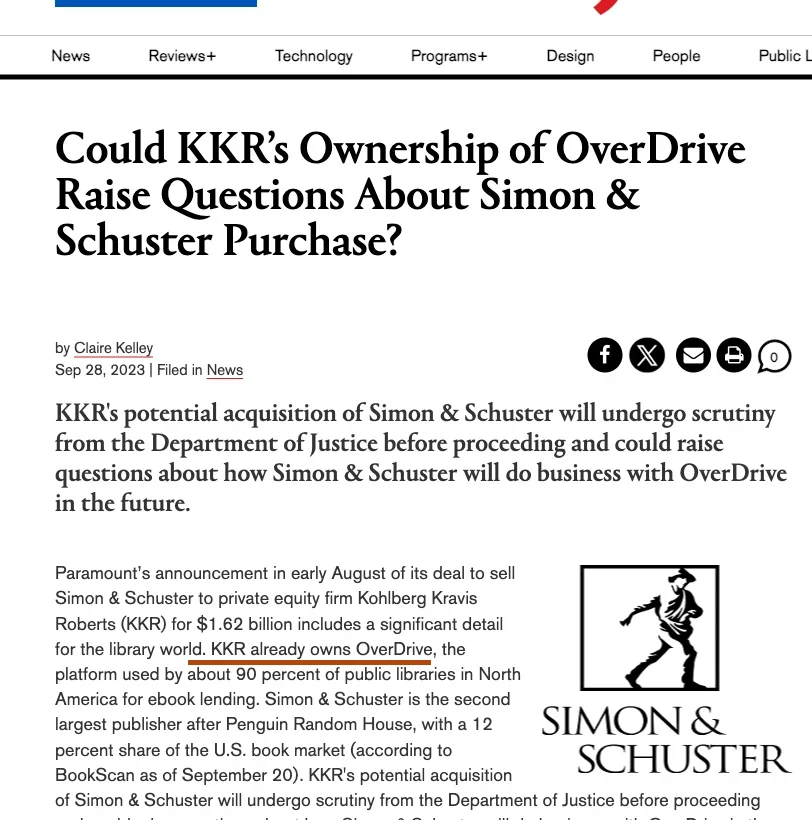
On August 7, 2023, Paramount and KKR announced an agreement for KKR to acquire Simon & Schuster for $1.62 billion in cash. Agreement was not completion.
On October 30, 2023, KKR announced completion of the $1.62 billion transaction. Its release also describes an employee ownership program and notes that references to KKR investments may include sponsored funds and insurance subsidiaries.
These announcements document KKR-linked transactions involving a library lending platform and a publisher. They are a reason to investigate relationships across the digital shelf. They do not provide a complete ownership chart today or establish that the businesses coordinate library prices or data practices.
Why a library should care
The useful question is what a library can decide for itself. Who can change the service? What does the library receive for its payment? What can it take with it if it leaves?
An ownership record helps identify whose incentives and responsibilities to examine. The contract is where a library must check its own rights. A company acquisition does not tell you what your agreement permits.
Bring three questions to renewal
- Who controls our contracting entity, and what has changed since the last renewal? Ask for a dated explanation of the relevant companies and investment funds.
- What uses of collection and usage data does our contract authorize? Ask which clauses govern sharing, analytics, retention, and any available choices.
- If we leave, what can we export, in which format, and what access or records would we lose? Ask for a sample export and the terms that apply.
Put the vendor’s answer beside the contract language and the date. Where they differ, keep asking. You should be able to explain the decision to the people who fund the library.
A short evidence sheet
The finding: OverDrive’s 2020 announcement and KKR’s 2023 announcement document two completed transactions. The agreement and completion dates have different meanings.
The open question: What legal ownership and control relationships apply at the time of your decision? Obtain current records rather than treating these historical announcements as a current chart.
Primary sources
- OverDrive’s Libby product page, section identifying the maker.
- OverDrive completion release, June 9, 2020, opening and fund paragraphs.
- Paramount agreement release, August 7, 2023, opening paragraph.
- KKR completion release, October 30, 2023, opening, employee ownership, and About KKR passages.
Source text checked online October 25, 2026. These links are publisher pages, not preserved copies stored in this preview.
Correction and local revision
October 25, 2026: corrected attribution of the 2020 release to OverDrive; separated the 2023 agreement from completion using the issuers’ announcements; replaced the opening present-tense common-ownership claim with dated transaction findings. The earlier draft did not establish a complete current ownership structure. Removed the unsupported “dominant” description and the separate analytics-product assertion from this account. The original draft remains preserved locally.
Method and correctionsSend a source or correction
Disclosure: I worked at OverDrive from 2008 to 2011, before the 2020 transaction.