OC-013·Overdue Conversation
Baker & Taylor Sold Its Library Ebook Platform for $750,000. The New Owner Brought In the Team That Ran It.
Built mostly out of Baker & Taylor's own bankruptcy filings, signed under oath and filed with the court. What the documents say, what they do not say, and the questions libraries may want to ask next. Disclosure: I worked at Baker & Taylor, on the software side, years before these events.
Published 2026.06.09Updated 2026.09.12MethodSend a correction
In this file
This article is based mostly on Baker & Taylor's own bankruptcy filings. Those filings were signed under oath and filed with the court.
I will walk through what the documents say, what they do not say, and what questions libraries may want to ask next.
Library software is not just software. It affects budgets, staff time, patron privacy, data access, and long-term control.
When a library platform is sold or relaunched, libraries should understand what changed, who owns it now, and what they may be asked to pay for next.
If you take one thing from this piece into your next vendor meeting or renewal, take this:
If this platform changes ownership, shuts down, relaunches, or changes pricing, what happens to our data, access, contracts, and patrons?
The $750,000 sale
Baker & Taylor was almost 200 years old when it entered Chapter 11 bankruptcy.
For many library workers, Baker & Taylor was more than a vendor. It was part of daily library life: boxes, processing slips, cataloging services, collection tools, conference booths, bookmarks, posters, and the famous cats.

Baker & Taylor helped libraries buy, catalog, process, and manage materials. For many libraries, that support mattered. It helped small teams do more with limited time and limited budgets.
That history matters because library technology is built on trust. Once a library uses a system for years, the system becomes part of daily work. Staff learn it. Local processes grow around it. Leaving becomes hard.
Over time, Baker & Taylor changed owners. As ownership changed, the business pressures changed too. Long relationships with libraries still mattered, but they were also weighed against debt, margins, growth goals, and investor expectations.
COVID-19 also played a role. The pandemic put pressure on libraries, publishing, retail, and supply chains. Baker & Taylor may have faced trouble without COVID, but the pandemic likely made the timing and damage worse.
The bankruptcy and layoffs were covered elsewhere. What caught my attention was one line in a sworn financial filing.
In Baker & Taylor's Statement of Financial Affairs, the form a company signs under oath listing what it transferred before filing, the company listed the sale of its digital library business for $750,000.
Not the whole company.
Just the digital platform. The print publishing-services unit went to a different buyer.
The filing calls the asset only "Digital Pub business." LibraryOne's own launch announcement, April 2026, says what that included:
- Boundless, the ebook and audiobook app once called Axis 360
- TitleSource360, the title selection and ordering tool
- ePopUp Library
- Content Café, a book-jacket and metadata service that Baker & Taylor resold under an agreement with Clarivate, which its schedules still list as a Baker & Taylor contract in April 2026
- CollectConnect, a state analytics product
The sale closed through two purchase agreements on December 15 and December 24, 2025.
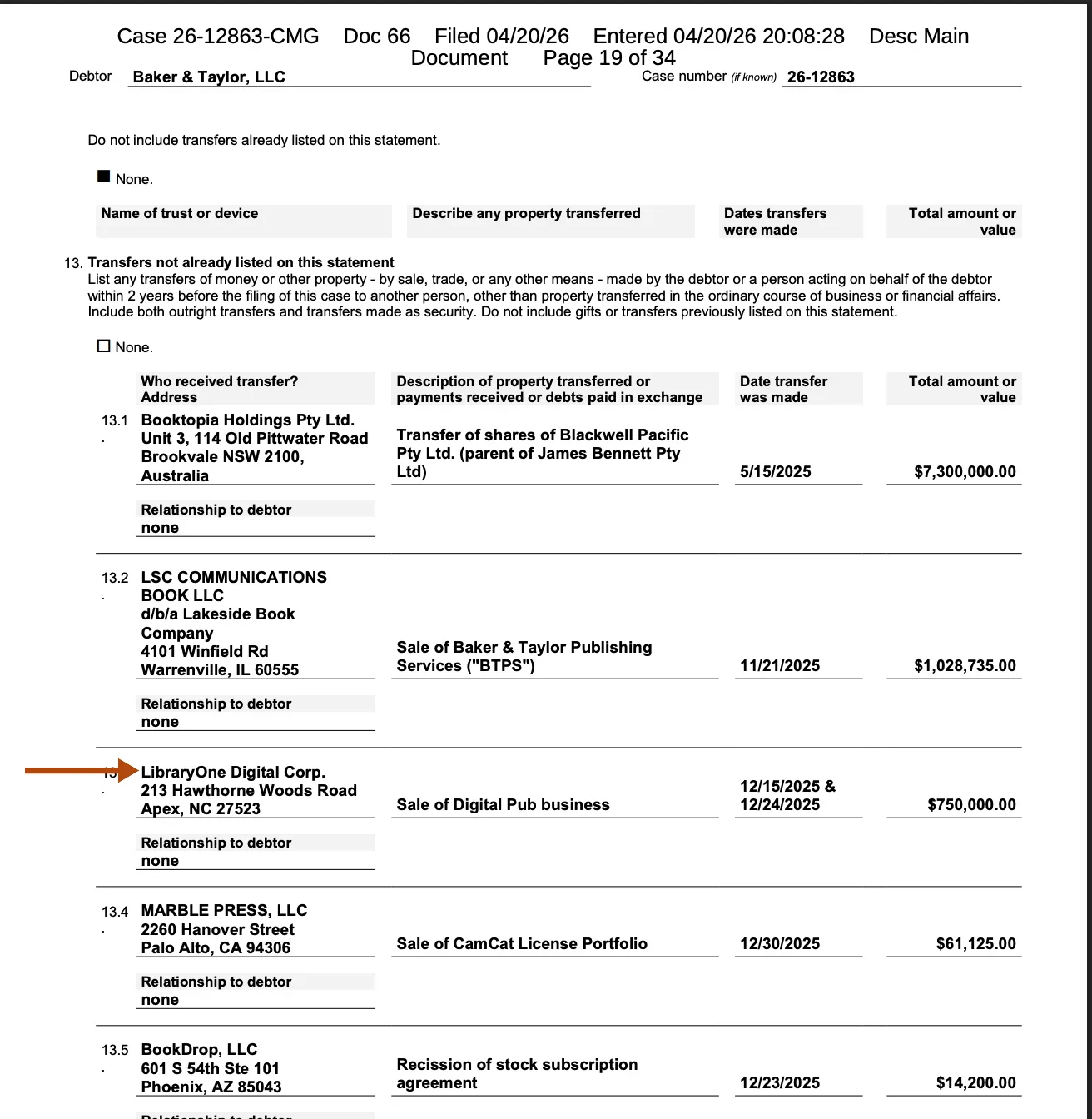
The same filing also listed other sales. Baker & Taylor Publishing Services sold to Lakeside Book Company for about $1.03 million. A fulfillment-center building went for $18.5 million in a 2024 sale-leaseback, which is a financing deal, not a comparable sale: the company kept using the building under a lease, and its declaration puts the capitalized lease liability for its two fulfillment centers together at about $43 million.
That means the digital business sold for less than the print publishing-services unit.
That does not prove anything improper, and the sworn record says more about how the price came about than the one line on the transfer schedule does.
Two declarations filed with the petition describe the sale. The CEO's declaration (Doc 9, paragraphs 31 and 32) says that from October to December 2025 Baker & Taylor "marketed and ultimately sold" the digital business, and that its lender, CIT, "issued a partial lien release to facilitate the transaction."
The declaration of Daniel Fishman of Riveron, the company's financial advisor (Doc 10, paragraphs 13 and 17), says the sale came "after entertaining offers from several parties," that Riveron ran "extensive marketing efforts and market testing," and that in his professional opinion the wind-down sales as a group "represented commercially reasonable transactions under the circumstances." The CEO's declaration (paragraph 37) says the proceeds of those sales were applied to the CIT loan, which had stood above $30 million in August 2025 and was paid off in full on February 13, 2026.
So the record describes a marketed sale with more than one bidder, approved by the secured lender, and covered by the advisor's sworn opinion that the wind-down sales were commercially reasonable. A low sale price can happen for many reasons. The platform was losing customers. Parts of it were shutting down. Bankruptcy lowers prices.
Still, the number is worth noticing, and so is who ended up running the asset.
This was not a random side product. It included tools connected to ebook lending, title selection, ordering, metadata, and analytics. Those are important parts of library work now.
The real question is not only whether $750,000 was too low. I do not know that.
The better question is: what should libraries understand when a platform they depended on is sold, relaunched, and offered back to the same market?
Who bought it
The buyer listed in the filing is LibraryOne Digital.
LibraryOne Digital Inc. was incorporated in North Carolina on December 8, 2025. That was shortly before the two purchase agreements closed in December. The company launched publicly in April 2026.
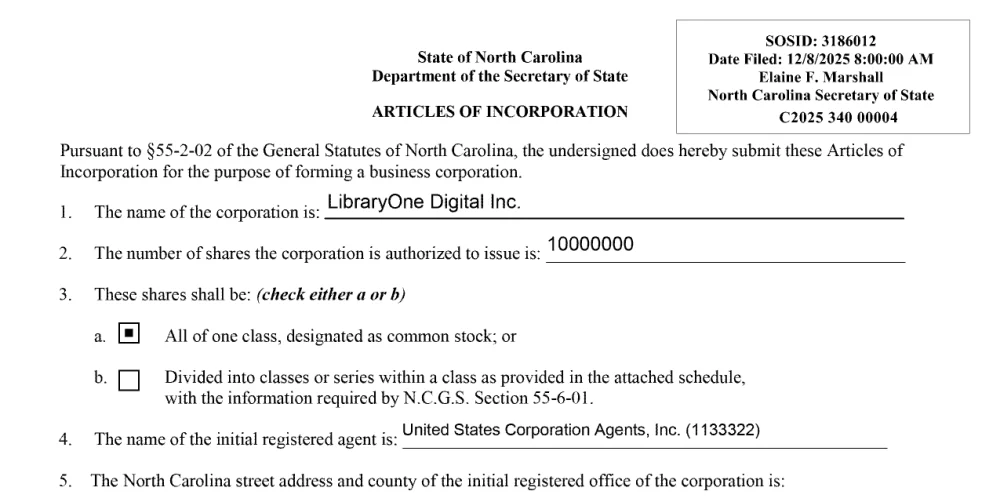
The two officers of record, Hari Katukota (president) and Manjunath Ratakonda (incorporator, secretary and treasurer), were not Baker & Taylor people. LibraryOne's own launch announcement says the company was founded by the two of them and that they "brought in" Bharat Mirgan from Baker & Taylor. Who holds the equity beyond those two is not in any public record I have found.
Below the two founders, the public record shows a lot of overlap between LibraryOne Digital and Baker & Taylor's former digital team.
LibraryOne's CEO, Bharat Mirgan, previously led digital operations at Baker & Taylor. LibraryOne's own public materials say he helped lead the development and launch of Boundless and ePopUp Library while he was at Baker & Taylor.
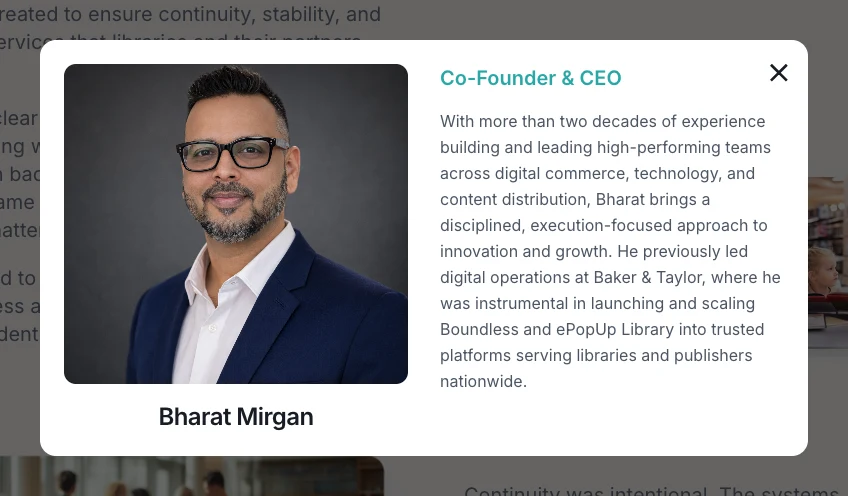
Other LibraryOne leaders also list Baker & Taylor experience, in customer success and publisher relations among other roles.
Five of the nine names on LibraryOne's leadership page as captured in May 2026 also appear in Baker & Taylor's sworn priority-wage list (Schedule E/F, Doc 65, Part 1, where each is listed "for notice purposes only," four at $0.00 and one as "Unknown"): Mirgan, Rod Riley, Arun Seth, Christina Bahnsen, and Michele Ogletree. The page has since changed; by September 2026 it listed seven leaders, three of whose bios name Baker & Taylor.
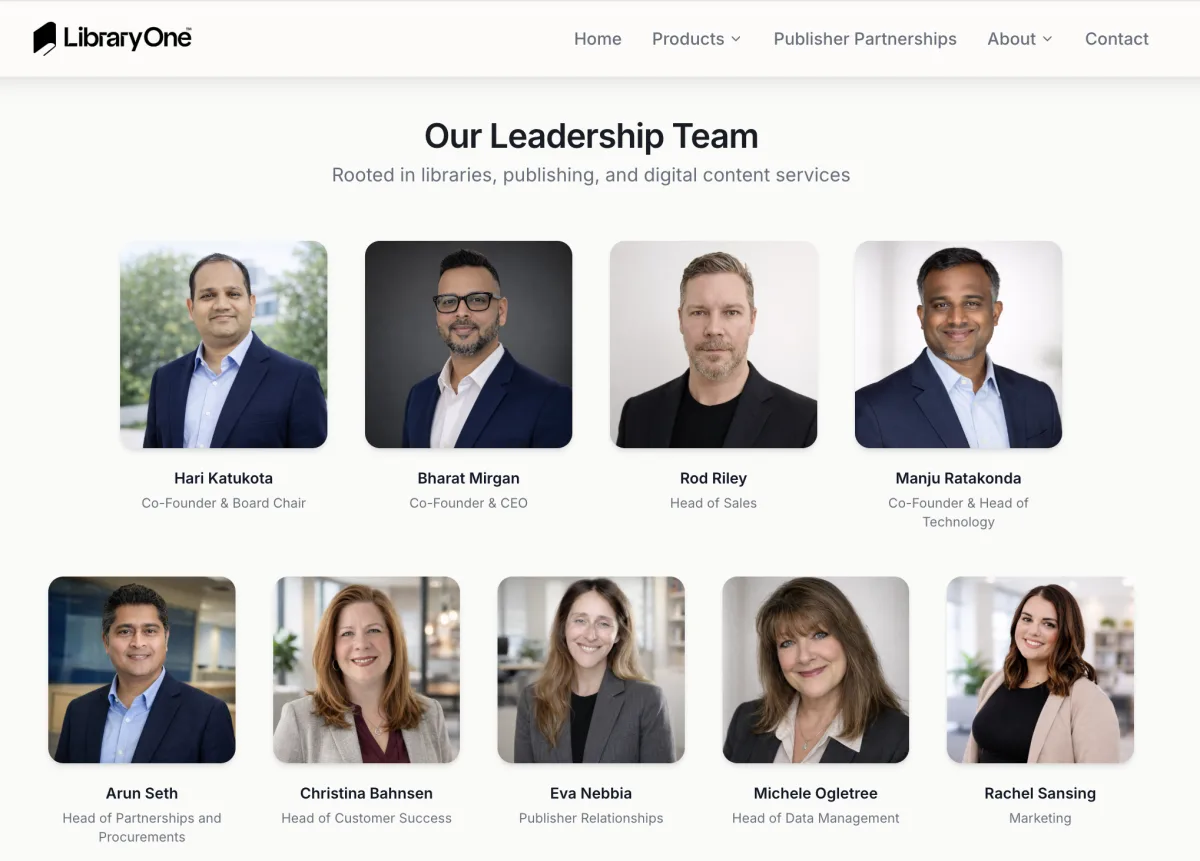
This does not mean Baker & Taylor's former corporate leadership controls LibraryOne. LibraryOne has said it has no involvement from Baker & Taylor's former corporate leadership.
That distinction matters.
There is a difference between former corporate leaders, former staff, former product leaders, legal insiders, and people who know the platform well. Those are not the same thing.
Here is the plain version.
A newly formed company bought Baker & Taylor's digital library platform assets for $750,000. Many people on that company's public team had worked on or around those same digital products at Baker & Taylor.
That is not an accusation. It is what the public record shows.
It is also something libraries should understand before making decisions about trust, pricing, and continuity.
What I am not saying
Nothing here is a finding of illegality, an unfair price, or a false filing. Former Baker & Taylor staff staying in library technology is not wrongdoing, and no court has been asked to act.
As of September 10, 2026, with the main docket at entry 161, no trustee, creditor, or committee had filed an action to challenge this sale, and the only two adversary proceedings on record are employee wage cases. There is an official creditors' committee, and in August it took document production from the company under a protective order (Docs 149 and 152); what it is examining is not public. In late August the company filed a Chapter 11 plan (Doc 154), which is the document that will eventually say what, if anything, the estate pursues. I have not obtained a copy.
There is also a serious argument that the sale price may make sense.
By December 2025, the asset was under pressure. The CEO's declaration (Doc 9, paragraph 30) says the company had "turned back towards a wind down of its operations," publicly announced bulk sales of its inventory, and "accelerated its efforts" to sell the digital business. A platform whose owner is winding down around it may not sell for much.
A low price for a troubled asset is ordinary.
What I am saying is narrower. This sale raises fair questions. Libraries should not be expected to treat it as routine without understanding what changed, what stayed the same, and what happens next.
The record shows the sale. It shows the price. It shows the buyer. It shows the timing. It shows a marketed process with several offers. It also shows staff continuity.
It does not answer every question.
Those unanswered questions belong in board packets, vendor meetings, budget talks, and renewal reviews.
The pattern this fits
This story feels familiar because libraries have seen this pattern before.
A library needs a tool. The library has money, but not always the staff or time to build the tool itself. So a vendor builds it.
Libraries use the product for years. They pay for it. They give feedback. Staff build workflows around it. The product becomes part of library infrastructure.
Then ownership changes.
The product may become part of a larger company. The company may take on debt. The market may change. Library budgets may stay flat. The business around the product may become unstable.
If the company fails, the product may not disappear. Useful pieces can be sold, moved, renamed, or relaunched.
From a business point of view, that can make sense. It may save jobs. It may keep a useful tool alive. It may keep customers from losing access right away.
But from a library point of view, it raises important questions.
Libraries may have paid into the platform for years. They may have helped shape it through orders, support tickets, meetings, feedback, and daily use.
If the same type of tool comes back under a new company, libraries should know what they are buying.
Are they paying for continuity?
Are they paying for a relaunch?
Are they paying for a replacement?
Are they now paying separately for something that used to be included?
Are they working with a new company that has the same product knowledge but different debts and duties?
None of those answers are automatically bad. But they should be clear.
You have seen a version of this on this site. Who owns Libby traces common ownership across the platforms libraries lend through, and OverDrive's Amplify product shows patron reading behavior becoming something sold to publishers. Those pieces establish ownership and a product, not a mechanism, and this one is a different case again: a lender-approved liquidation sale, not a private-equity hold. What the cases share is the question, not the answer. Who owns the tool your library depends on, and what did they pay for it?
Why TitleSource360 matters
TitleSource360 is a good example of why this matters.
Under Baker & Taylor, TitleSource360 helped librarians search for titles, read reviews, see upcoming releases, check what they already owned, and build order lists.
It supported buying.
Because libraries placed orders through Baker & Taylor, the tool was part of the buying relationship. Baker & Taylor made money when libraries ordered materials.
If a tool like that moves into a new company, the pricing model may change.
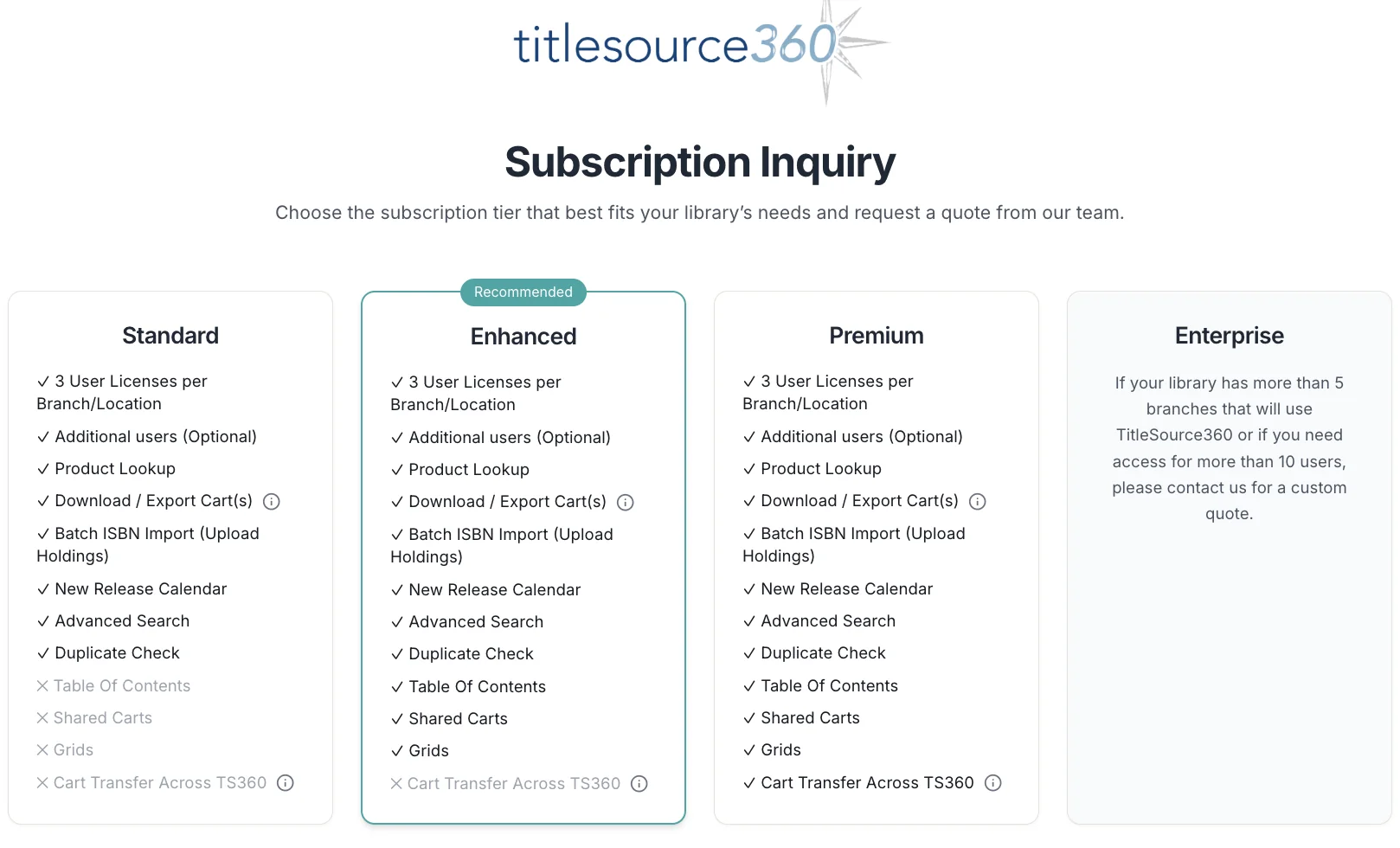
Under LibraryOne, TitleSource360 is a tiered paid subscription, quoted on request, and, as Publishers Weekly reported in April 2026, it "does not allow for print ordering at this time." So the thing that paid for the tool under Baker & Taylor, the wholesale orders it generated, is gone from it.
That does not automatically make the change wrong. A separate company has different costs and needs than a wholesaler.
But libraries should be able to ask a basic question: are we now being charged for the search-and-selection half of a tool whose ordering half paid for it?
That question is not anti-vendor.
It is responsible budgeting.
Libraries are allowed to ask what they are paying for. They are allowed to ask whether a workflow that used to be included is now a subscription. They are allowed to ask what happens to their data, lists, reviews, order history, analytics, and export rights.
They are allowed to ask before they sign.
The library question
The main issue is not whether former Baker & Taylor employees were allowed to keep working in the field.
Of course they were.
People do not become suspicious because they survive a bankruptcy, keep their skills, or try to keep useful technology going. Staff continuity can be valuable. In some cases, it may be the reason a product survives at all.
The issue is not staff survival.
The issue is visibility.
Libraries should be able to see who owns the platform now, what assets were sold, what data moved, what data did not move, what contracts continue, what contracts ended, what features are being retired, what tools are being repriced, what duties the new company accepts, and what libraries can do if they want to leave.
That is the practical heart of this story.
When library technology changes hands, trust should not be automatic just because the product, staff, or customer relationship feels familiar.
Trust has to be rebuilt.
Questions libraries should ask next
If your library is reviewing a platform that changed hands, relaunched, or came out of a failed company, ask these before you renew or buy:
- Who owns the platform now?
- What assets were purchased?
- What was not included in the purchase?
- Did customer data transfer?
- Did usage data, order history, lists, metadata, or settings transfer?
- Are any tools that used to be included now priced separately?
- What happens if the company retires the product?
- Can we export our records without paying for a special project?
- Can we export our lists, usage data, invoices, and settings?
- What outside systems, APIs, publishers, or contracts does the service depend on?
- What promises are made to current customers?
- How much notice will libraries get before access, pricing, or features change?
- What happens to patron data if the service ends?
These questions are not accusations.
They are basic procurement hygiene.
If a platform is important enough to run library services, it is important enough to inspect.
If your library prepaid Baker & Taylor, check this before September
Governmental bar date: September 14, 2026. The general bar date has already passed.
This is the one item on this page with a deadline attached, and the good news is that most libraries have less to do than you would expect.
Correction, July 30, 2026. An earlier version of this section said about a thousand libraries were scheduled with a protected balance while hundreds more were flagged "disputed" or "contingent" and would recover nothing unless they filed. Both halves were wrong, and the corrected version is less alarming, so it is worth stating plainly.
The "thousand" figure came from an exhibit that is actually Baker & Taylor's accounts receivable, meaning libraries that owe the company, not libraries it owes. The "flagged" count was an artifact of reading a scanned form with a text tool: the words "Contingent," "Unliquidated" and "Disputed" are printed next to every entry as checkbox labels, whether or not the box is ticked.
Rendering the 183 pages of general unsecured creditors as images and reading the checkboxes gives the real answer, and re-counting every checkbox glyph across the whole 514-page filing on September 10 gives the same one. The entire Schedule E/F, 1,894 entries, contains eight ticked flags, and not one of them is a library. Three are landlords with lease-rejection damages, one is OCLC, two are individuals in litigation with the company, one is a publisher, and one is a pottery company that stores Baker & Taylor equipment.
So: every library on Baker & Taylor's schedule is listed with a stated dollar amount, undisputed and non-contingent. One of those amounts is $0.00 (Lincoln Library). Under the bar date order, a creditor scheduled that way does not have to file a proof of claim at all, as long as it agrees with the amount, the nature and the priority.
Palm Beach County Library System, scheduled at $1,373,014.80 and the largest library creditor in the case, had not filed as of a register pull on September 10. If it agrees with that figure, it does not need to. Richland County Public Library, scheduled at $985,722.07, filed anyway on July 16 for the identical amount, which is a reasonable belt-and-braces move but was not required.
The low library filing rate is not libraries sleeping through a deadline. It is not the schedule being right, either. Of the 40 libraries that both filed a claim and appear on the schedule under the same name or address, only 3 filed the scheduled figure exactly and 9 came within 5 percent. Twenty filed for less than Baker & Taylor scheduled them, and 8 filed for more, in two cases by more than $40,000. The libraries that checked mostly found a different number. That is the argument for checking.
The court's bar date order (Doc 118, entered June 11, 2026) set two deadlines, and only one of them is still open.
There are still three groups with something to do, and they are narrower than I first wrote.
If your scheduled amount is wrong or too low. Look yourself up in Schedule E/F (Doc 65) and compare the figure to your own records. The schedule is what governs if you do not file, so if it understates what you prepaid, the difference is only recoverable by filing a proof of claim. The bar date order puts the burden of checking on you, not on the debtor.
If you have a contract but no creditor entry. Schedule G, the contract list in the same filing, names 53 counterparties with live library distribution contracts, and 35 of them (Phoenix, Boston, Austin, Memphis, Nashville, Spokane, Hennepin County, Los Angeles County and 27 more) appear nowhere in Schedule E/F. They were added to the mailing list for notice (Doc 67) and scheduled for no amount. A contract is not a debt, but if one of those libraries prepaid, the schedule does not say so.
If you prepaid but are not on the schedule at all. This is the group most likely to lose money, and the likeliest members of it are library foundations and Friends groups, because they are separate legal entities from the library. If the payment came from the foundation's account, the foundation is the creditor, and it may simply be absent from a schedule built from the library's name. Four libraries that filed claims are on no schedule under any name, and the largest is a county library system, not a foundation. The schedule cannot show you whether you are in this group. Your own bank records can.
For all three, the deadline is September 14, 2026 if you are a governmental unit, and it was July 17, 2026 if you are not. A nonprofit, association library, foundation, Friends group or consortium was on the July date. Missing it does not automatically make a claim worthless, but the simple route is closed: a late claim has to be taken up with the court, which is a question for your counsel.
Which category your library falls into is easy to get wrong, and it is the thing to confirm first.
And note: asking Baker & Taylor for a refund does nothing now, because the company is in bankruptcy. The only way to recover anything is through the claims process in the case.
What good stewardship would look like
Good stewardship does not require perfection.
It requires clarity.
For libraries, that could include a plain-language explanation of what changed, a clear list of affected products, public or predictable pricing, export tools before shutdowns or migrations, written promises about patron data, transition plans for libraries still under contract, clear information about order history and metadata, clear support contacts, and a timeline libraries can plan around.
A new owner inherits the contracts. Whether it inherits the trust is the library's call.
Libraries may decide to keep using a relaunched platform. They may value familiar staff, familiar workflows, and a tool that still solves a real problem.
That is a valid choice.
But the choice should be made with the facts in view.
The point
The point is not that every sale is suspicious.
The point is that library infrastructure should not move through bankruptcy, asset sales, relaunches, and pricing changes in a fog.
Libraries are public institutions. Their technology choices affect public money, staff labor, patron access, privacy, and service continuity.
When a digital platform is sold for $750,000, when the buyer is newly formed, when the team overlaps with the old platform team, and when the product returns to the same market, libraries should ask careful questions.
Not because anyone necessarily did anything wrong.
Because careful questions are how public institutions protect themselves.
A platform can fail, shed its debt, keep its product knowledge, and return to the market under a new name.
That may be legal. It may even keep something useful alive.
But libraries still deserve to know what they are buying back.
Sources
The $750,000 sale, the comparative sale prices, and the classification of the transfer: Baker & Taylor, LLC, Statement of Financial Affairs (Doc 66, Item 13), filed April 20, 2026, Case No. 26-12863-CMG, U.S. Bankruptcy Court, District of New Jersey.
The sale process: Declaration of Amandeep Kochar, Doc 9, paragraphs 30 to 32 and 45, and Declaration of Daniel Scott Fishman (Riveron), Doc 10, paragraphs 13, 16 and 17, both filed March 16, 2026. The quoted phrases are verbatim from those paragraphs.
The employee overlap: Baker & Taylor's Schedule E/F (Doc 65), Part 1, entries 2.47 (Seth), 2.67 (Mirgan), 2.110 (Bahnsen), 2.430 (Ogletree) and 2.494 (Rodney P. Riley, matched to LibraryOne's Rod Riley by name), against LibraryOne's leadership page as captured in April 2026 (nine leaders) and read again September 11, 2026 (seven leaders, three bios naming Baker & Taylor). The founders, Katukota and Ratakonda, are the two officers on the North Carolina filing and appear nowhere in Baker & Taylor's schedules. The product list is from LibraryOne's April 15, 2026 launch announcement; no Baker & Taylor filing names a product.
The formation date: LibraryOne Digital Inc., Articles of Incorporation, filed with the North Carolina Secretary of State, SOSID 3186012, doc C2025 340 00004 (the incorporation filing, PDF; North Carolina Secretary of State business registration search).
Creditor amounts (Palm Beach County, Richland County): Form 204 / Doc 1, and Schedule E/F, Doc 65, entries 3.849 and 3.953. Contract libraries: Schedule G in Doc 65 and the amended creditor matrix, Doc 67. Filing status: Omni claims-register exports of July 30 and September 10, 2026. Bar dates: order entered June 11, 2026 (Doc 118), setting a general claims bar date of July 17, 2026, 5:00 p.m. ET, and a governmental-unit bar date of September 14, 2026. Case documents are public through the claims agent, Omni Agent Solutions: cases.omniagentsolutions.com.
TitleSource360's move to a tiered paid subscription under LibraryOne: LibraryOne's own TitleSource360 page; Bharat Mirgan, Publishers Weekly interview, April 2026 (print ordering removed under LibraryOne); and a practitioner read on the shift, Jim Flury (The Library Network, Michigan), on the michlib-l mailing list thread, February 2026.
Background on the collapse, the OCLC litigation, the 2016 Follett acquisition and the 2021 Kochar buyout: Marshall Breeding, Library Technology Guides. LibraryOne's launch and leadership were also covered by Publishers Weekly (April 2026) and Library Journal (April 2026).
How these filings are sourced: how I report and source these filings.
What I have not claimed, and what is not established:
- That the $750,000 was below fair value. The advisor's sworn opinion is that it was commercially reasonable; no one has litigated the point; the asset was deteriorating at the time of sale.
- That any party misrepresented anything. Baker & Taylor's "Relationship to debtor: none" and LibraryOne's "no former corporate leadership" are both accurate as written.
- That the ex-Baker & Taylor executives own LibraryOne. The officers of record are two people who never worked there; the cap table is not public.
- That any court has found wrongdoing. The docket statement above is current to September 10, 2026 (Doc 161).
Disclosure: I previously worked at Baker & Taylor on the software side. I left in 2021, before the events described here.
Filed June 2026. Rewritten for clarity and plain language on July 30, 2026, and corrected the same day. Revised September 11, 2026 to add the sale-process declarations (Docs 9 and 10), correct the title, and re-check the docket.
The correction, stated plainly because it ran against this piece's own argument. The bar-date section previously told libraries that hundreds of them had claims flagged "disputed" or "contingent" carrying no dollar figure, and that missing a deadline meant recovering "zero, not pennies." That was wrong in a way that made the situation sound worse than it is. Both figures behind it came from reading a scanned court form with a text-extraction tool, which cannot see whether a checkbox is ticked and reproduces the printed labels "Contingent / Unliquidated / Disputed" next to every single entry.
The separate "about a thousand libraries scheduled" figure came from an exhibit that is Baker & Taylor's accounts receivable, meaning libraries that owe the company rather than libraries it owes.
Rendering the 183 pages of general unsecured creditors as images, and re-counting the whole filing from the PDF's checkbox glyphs on September 10, 2026, both show eight ticked flags in the whole document, none of them a library. Every scheduled library carries a stated, undisputed amount, and under the bar date order such a creditor need not file at all.
The sale price, the dates, the buyer, the creditor amounts and the bar dates are unchanged. One earlier revision also stands: TitleSource360 is described as having come with the ordering relationship rather than as "free." The September 11 revision changed the title from "The Buyers Are the Team That Ran It" to "The New Owner Brought In the Team That Ran It," because the buyer's officers of record were never at Baker & Taylor, and added the two sworn declarations describing the sale as marketed with several offers, which the earlier versions did not mention.
Disclosure: L/30 and MetisLib are mine. Both are open source, neither takes real patron data, and neither is sold to anyone.
One more disclosure, specific to this piece: I used to work at Baker & Taylor, on the software side. That was years before these events. It gives me a point of view. It does not give me inside knowledge about this sale.